

Have you ever wondered whether to write itself or its self? These two forms look almost identical, but they have different uses in English. Choosing the correct form can make your writing clearer and help you avoid common grammar mistakes.
The good news is that the rule is simple. Itself is the standard reflexive pronoun used when something refers back to itself. For example, “The cat cleaned itself.” In contrast, its self is rarely used as a separate phrase. It may appear when self is treated as a noun, especially in philosophical or specialized writing.
Understanding the difference between these forms will help you improve your English grammar, spelling, sentence structure, and writing skills. In this guide, you will learn the definitions, grammar rules, examples, common mistakes, and practical ways to choose the correct form.
What Is the Difference Between Itself and Its Self?
The main difference between itself and its self is how the words function in a sentence.
Itself is a reflexive pronoun. It refers back to a singular thing, animal, organization, or other nonhuman subject. It can also add emphasis.
Its self consists of the possessive determiner its and the noun self. This combination is unusual in everyday English. Writers may use it when discussing a separate or essential self in philosophical, psychological, or specialized contexts.
Consider these examples:
- Itself: The machine turned itself off.
- Itself: The company itself announced the changes.
- Its self: The writer explored the concept of the machine’s inner self, rather than treating it as a mere object.
Notice that the last example uses its inner self, not its self. This is a more natural way to express the idea in ordinary English.
Quick answer: Use itself in almost all ordinary sentences. Use its self only when the context specifically requires self to function as a separate noun, and consider a more natural alternative when possible.
Definition of Itself
Itself is a singular reflexive pronoun. It refers back to a subject represented by it.
Reflexive pronouns are used when the subject and object of an action refer to the same person or thing. They can also emphasize the subject.
Examples:
- The dog scratched itself.
- The door closed itself.
- The computer restarted itself.
- The building itself is impressive.
- The problem will solve itself eventually.
In the first three examples, itself refers back to the subject. In the final two, it adds emphasis or expresses an outcome that happens without direct intervention.
When Should You Use Itself?
Use itself in these situations:
- Reflexive actions: The animal washed itself.
- Emphasis: The school itself organized the event.
- Automatic actions: The program updates itself.
- Natural or expected outcomes: The situation will resolve itself.
In everyday writing, itself is the normal choice for these meanings.
Definition of Its Self
Its self combines the possessive determiner its with the noun self. However, this combination is not a standard substitute for the reflexive pronoun itself.
The word self can be a noun that refers to an individual’s identity, essential nature, or personal being. When using this meaning, English usually adds a descriptive word or uses a possessive construction that sounds natural.
Examples:
- The animal returned to its natural self after recovering.
- The organization wanted to rediscover its former self.
- The character struggled to understand its true self.
- The company presented its best self to the public.
These examples use its with a noun phrase, such as natural self, former self, true self, or best self.
Although its self may occur in specialized writing, it is unusual in ordinary English. If you want to describe the identity or nature of something, phrases such as its true nature, its original form, or its former self are often clearer.
Read More: 75 Other Ways to Say Attention to Detail (With Examples 2027)
Sentence Structure: Itself vs Its Self
Understanding sentence structure makes the difference easier to remember.
1. Itself as a Reflexive Pronoun
The common pattern is:
Subject + Verb + Itself
Examples:
- The baby entertained itself.
- The phone switched itself off.
- The bird protected itself.
- The application installed itself.
In each sentence, itself refers to the subject.
Another pattern uses itself for emphasis:
Subject + Itself + Verb or Complement
Examples:
- The manager herself approved the plan. (Use himself or herself for a human subject, as appropriate.)
- The building itself is beautiful.
- The rule itself is easy to understand.
Here, itself emphasizes a nonhuman subject.
2. Its + Noun
The usual pattern for expressing possession is:
Subject + Verb + Its + Noun
Examples:
- The dog wagged its tail.
- The company changed its policy.
- The tree lost its leaves.
- The country celebrated its independence.
In these sentences, its shows possession. The following noun identifies what belongs to the subject.
3. Its + Descriptive Word + Self
When discussing identity or nature, this structure is often more natural:
Subject + Verb + Its + Adjective + Self
Examples:
- The city is returning to its former self.
- The character is learning to accept its true self.
- The company wants to present its best self.
- The ecosystem is gradually restoring its natural self.
This structure works because self is being used as a noun with a descriptive word.
Rules for Using Itself and Its Self
Follow these simple rules to choose the correct form.
Rule 1: Use Itself for Reflexive Actions
When a thing performs an action that affects the same thing, use itself.
Examples:
- The cat cleaned itself.
- The engine shut itself down.
- The child amused itself with toys.
- The robot moved itself across the room.
Do not write the cat cleaned its self when you mean that the cat cleaned its own body.
Rule 2: Use Itself for Emphasis
You can use itself to emphasize a thing rather than another person or thing.
Examples:
- The house itself is worth visiting.
- The evidence itself is convincing.
- The question itself is difficult.
- The proposal itself contains several useful ideas.
In these examples, itself adds emphasis rather than serving as the object of an action.
Rule 3: Use Its Before a Noun to Show Possession
Use its when you mean that something belongs to or is associated with a thing.
Examples:
- The company updated its website.
- The bird spread its wings.
- The school announced its schedule.
- The phone lost its connection.
Remember that its does not need an apostrophe to show possession.
Rule 4: Use a Descriptive Word Before Self When Needed
When self refers to identity, condition, or nature, a descriptive word often makes the sentence clearer.
Examples:
- The town is returning to its former self.
- She wants the company to become its best self.
- The character finally accepts its true self.
These constructions are more natural than using its self without further context.
Rule 5: Do Not Confuse Its With It’s
This is one of the most common English grammar mistakes.
- Its means belonging to something.
- It’s is a contraction of it is or it has.
Examples:
- The dog wagged its tail.
- It’s raining outside.
- The company changed its name.
- It’s been a difficult day.
This rule is important because the apostrophe changes the meaning.
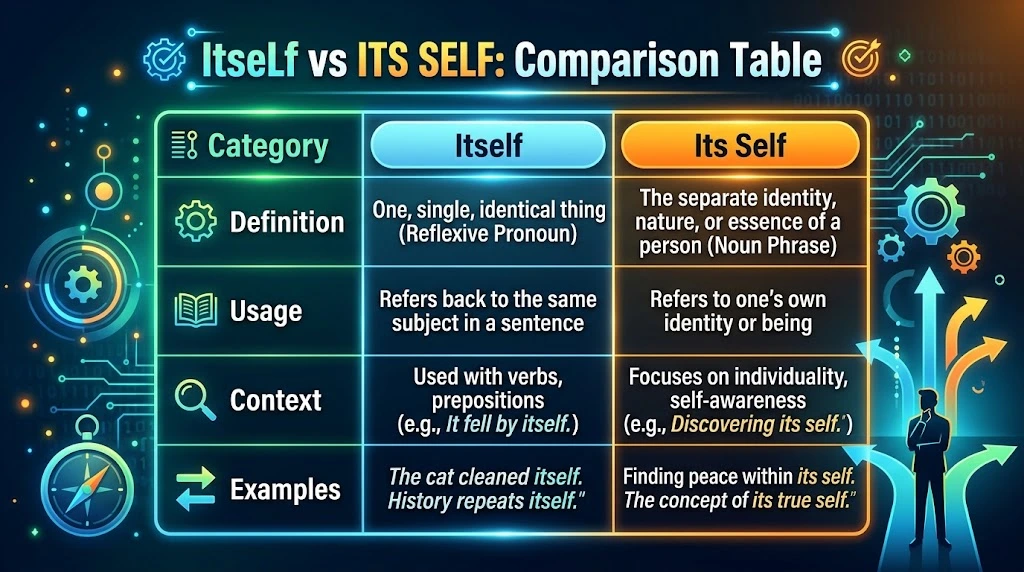
Itself vs Its Self: Comparison Table
| Feature | Itself | Its self |
| Grammar role | Reflexive or emphatic pronoun | Possessive determiner + noun |
| Common in everyday English | Yes | Rarely |
| Used for reflexive actions | Yes | No |
| Used for emphasis | Yes | Not in the same way |
| Used to discuss identity | Sometimes, depending on the sentence | Possible in specialized contexts |
| Example | The door closed itself. | The idea of its self was discussed philosophically. |
| Best everyday choice | Usually correct | Often better rewritten |
Remember: Itself is the standard form for ordinary reflexive and emphatic uses. If you intend to discuss identity, consider phrases such as its true self or its essential nature.
15 Examples of Itself in Sentences
Here are 15 useful examples showing how itself works in everyday English.
- The cat cleaned itself after eating.
- The door opened itself when the sensor detected movement.
- The computer restarted itself during the update.
- The company itself released the announcement.
- The problem will solve itself with time.
- The bird defended itself against the larger animal.
- The application installed itself automatically.
- The school itself organized the competition.
- The machine stopped itself when it overheated.
- The plant supports itself with strong roots.
- The town itself has several historic buildings.
- The device turns itself off after ten minutes.
- The animal hid itself among the leaves.
- The rule itself is not difficult to understand.
- The system corrected itself after the error.
These examples show that itself can describe an action, emphasize a subject, or express something that happens automatically.
10 Examples Using Its Before a Noun
The following sentences show how to use its correctly when expressing possession.
- The dog wagged its tail.
- The bird built its nest.
- The company changed its name.
- The tree lost its leaves.
- The phone needs its charger.
- The school updated its rules.
- The country celebrated its victory.
- The machine lost its power.
- The restaurant changed its menu.
- The computer saved its settings.
In every sentence, its comes before a noun. It tells the reader which tail, nest, name, leaves, or settings belong to the subject.
Common Mistakes With Itself and Its Self
Even advanced learners sometimes confuse reflexive pronouns with possessive words. Here are common mistakes and their corrections.
Mistake 1: Writing Its Self for a Reflexive Action
Incorrect: The dog washed its self.
Correct: The dog washed itself.
Why? The dog is performing an action on its own body. Therefore, the reflexive pronoun itself is needed.
Mistake 2: Using It’s Instead of Its
Incorrect: The company changed it’s policy.
Correct: The company changed its policy.
Why? The sentence expresses possession. The policy belongs to the company, so its is correct.
Mistake 3: Adding a Space to the Reflexive Pronoun
Incorrect: The computer repaired it self.
Correct: The computer repaired itself.
Why? Itself is written as one word when used as a reflexive pronoun.
Mistake 4: Using Itself When Possession Is Intended
Incorrect: The bird spread itself wings.
Correct: The bird spread its wings.
Why? The sentence refers to the bird’s wings. Use the possessive determiner its before the noun wings.
Mistake 5: Using Its Self Without a Clear Meaning
Awkward: The machine returned to its self.
Better: The machine returned to its original state.
Why? If you mean that the machine returned to its previous condition, original state expresses the idea more clearly.
Mistake 6: Using Itself for a Human Subject
Incorrect: Sarah blamed itself for the mistake.
Correct: Sarah blamed herself for the mistake.
Why? Use the appropriate human reflexive pronoun, such as himself, herself, or themselves, depending on the person and context.
How Itself Connects With Verbs
Itself is commonly used with verbs that describe actions directed back toward the subject.
Examples include:
- Wash: The cat washed itself.
- Protect: The animal protected itself.
- Move: The machine moved itself.
- Correct: The system corrected itself.
- Introduce: The program introduced itself.
- Control: The device controls itself.
- Prepare: The system prepared itself for the next stage.
The verb does not have to describe a physical action. It can also describe a change or process.
For example, “The situation corrected itself” means that the situation improved without someone directly correcting it.
Does Itself Change the Verb Form?
No. The subject determines the verb form, not the reflexive pronoun.
Compare these sentences:
- The machine works by itself.
- The machines work by themselves.
- The system has repaired itself.
- The systems have repaired themselves.
This is similar to the grammar rule for has vs have. A singular subject generally takes has in the present perfect, while a plural subject generally takes have.
Itself and English Tenses
The word itself can appear in different tenses. The tense depends on the verb in the sentence.
Present Simple
Use the present simple for habits, facts, and regular actions.
Examples:
- The machine cleans itself every day.
- The system checks itself automatically.
- The plant protects itself from some environmental conditions.
Past Simple
Use the past simple for completed actions in the past.
Examples:
- The door closed itself.
- The computer restarted itself.
- The animal defended itself.
Present Continuous
Use the present continuous for an action happening now.
Examples:
- The machine is adjusting itself.
- The system is updating itself.
- The organization is preparing itself for change.
Present Perfect
Use the present perfect for actions connected to the present.
Examples:
- The computer has restarted itself.
- The system has corrected itself.
- The organization has prepared itself for the changes.
Future Simple
Use the future simple for future events or predictions.
Examples:
- The problem will solve itself.
- The machine will turn itself off.
- The system will update itself overnight.
These examples also demonstrate how future indefinite tense examples are formed with will + base verb. The reflexive pronoun does not change this structure.
Itself in Clauses and Complex Sentences

A clause is a group of words containing a subject and a verb. The word itself can appear in independent and dependent clauses.
1. Independent Clauses
An independent clause expresses a complete thought.
Examples:
- The machine repaired itself.
- The company itself announced the decision.
- The problem eventually solved itself.
Each sentence can stand alone.
2. Dependent Clauses
A dependent clause cannot usually stand alone as a complete sentence.
Examples:
- Because the system restarted itself, the process began again.
- Although the machine protects itself, it still needs regular maintenance.
- When the door closes itself, the sensor stops working.
In these examples, itself remains a reflexive or emphatic pronoun. The clause structure does not change its function.
3. Conditional Sentences
Conditional sentences describe possible situations and their results.
Examples:
- If the system corrects itself, we will not need to restart it.
- If the door closes itself, check the safety sensor.
- If the problem solves itself, no further action may be necessary.
These sentences show that itself can appear naturally in conditional structures.
Itself vs It: What Is the Difference?
Although it and itself are related, they serve different grammatical purposes.
| Word | Function | Example |
| It | Subject or object pronoun | It works well. |
| Itself | Reflexive or emphatic pronoun | It repaired itself. |
| Its | Possessive determiner | Its battery is dead. |
| It’s | Contraction of it is or it has | It’s ready. |
Consider the following examples:
- It is broken. — It is the subject.
- I repaired it. — It is the object.
- It repaired itself. — The subject and object refer to the same thing.
- Its screen is cracked. — Its shows possession.
- It’s working again. — It’s means it is.
Understanding these differences will help you avoid many common grammar and spelling errors.
Quick Tips to Remember the Difference
Use these practical tips when writing or editing English sentences.
- Choose itself for reflexive actions.
Example: The cat groomed itself. - Choose its before a noun.
Example: The cat licked its paw. - Use it’s only for it is or it has.
Example: It’s working properly. - Write itself as one word.
Do not separate it into it self when you mean the reflexive pronoun. - Rewrite unusual uses of its self.
Instead of “The system returned to its self,” write “The system returned to its original state.” - Read the complete sentence.
Ask yourself whether you mean an action, possession, or identity. The meaning will usually reveal the correct form.
Frequently Asked Questions
1. Is Itself One Word or Two?
Itself is one word when used as a reflexive or emphatic pronoun. For example, “The machine turned itself off.” Writing it self is incorrect for this meaning.
2. Is Its Self Ever Correct?
Yes, it can occur when its is a possessive determiner and self is a separate noun. However, the phrase is unusual in everyday English. Expressions such as its true self or its former self are often more natural.
3. What Is the Difference Between Itself and Its?
Itself is a reflexive or emphatic pronoun, while its shows possession. For example, “The dog washed itself” and “The dog wagged its tail.”
4. Is Itself a Reflexive Pronoun?
Yes. Itself is a reflexive pronoun used when a nonhuman subject and the object refer to the same thing. For example, “The bird protected itself.”
5. What Is the Difference Between Its and It’s?
Its indicates possession, while it’s is a contraction of it is or it has. For example, “The company changed its logo” and “It’s a new logo.”
Conclusion
Understanding itself vs its self is easier when you focus on meaning and sentence structure. In everyday English, itself is the correct choice when a thing performs an action on itself or when you want to emphasize that thing. For example, “The machine turned itself off” is grammatically correct.
By contrast, its shows possession and normally comes before a noun, as in “The machine lost its power.” The phrase its self is uncommon and generally requires a special context in which self functions as a separate noun. Expressions such as its true self or its original state are often clearer.
Remember these simple rules, review the examples, and check your sentences before publishing or submitting your writing. With practice, you can use these forms confidently and improve your overall English grammar.

1 thought on “Itself vs Its Self: Which One Is Correct? Meaning, Rules, and Examples”