


Do you ever wonder whether to say “when can I” or “when I can”? Both expressions are correct in English, but they follow different sentence structures and serve different purposes. Choosing the right one depends on how you use it in a question or a statement.
For example, “When can I call you?” is a direct question asking about a suitable time. In contrast, “I will call you when I can” means that you will call when you have the time or opportunity.
The difference may seem small, but it matters in everyday conversations, professional emails, academic writing, and English exams. Understanding this grammar rule will help you speak more naturally and avoid common mistakes.
In this guide, you will learn the meaning of when can I vs when I can, the correct word order, practical examples, common errors, and the relationship between these expressions and English tenses. You will also find comparison tables and simple explanations to help you remember the rules.
What Is the Difference Between “When Can I” and “When I Can”?
The main difference is word order and sentence purpose.
- When can I is commonly used to begin a direct question. The modal verb can comes before the subject I.
- When I can usually appears inside a statement or an indirect question. The subject I comes before the verb can.
Examples:
- When can I submit my application? — A direct question.
- I will submit my application when I can. — A statement.
- Can you tell me when I can submit my application? — An indirect question.
Remember that neither expression is automatically wrong. The correct choice depends on the complete sentence.
Sentence Structure of “When Can I” vs “When I Can”
Understanding sentence structure is the easiest way to choose the correct expression.
1. When Can I: Direct Questions
Use this structure when asking a direct question about time, permission, ability, or opportunity.
Formula:
When + can + subject + base verb + …?
Examples:
- When can I leave?
- When can I start working?
- When can I meet the manager?
- When can I use your computer?
- When can I expect a reply?
In each example, can comes before the subject I.
This word order is called subject-auxiliary inversion. It is a common feature of direct questions in English.
2. When I Can: Statements
Use this structure when when I can appears within a statement.
Formula:
Main clause + when + subject + can + base verb.
Examples:
- I will help you when I can.
- I visit my grandparents when I can.
- I will finish the task when I can.
- I exercise when I can.
- I try to read when I can.
Here, the subject I comes before the modal verb can because the words form part of a larger sentence rather than a direct question.
3. When I Can: Indirect Questions
You can also use when I can in an indirect question.
Examples:
- Can you tell me when I can apply?
- Do you know when I can collect my certificate?
- Could you explain when I can access the website?
- I would like to know when I can schedule an appointment.
Although these sentences ask questions, the embedded part uses statement word order.
Compare these two sentences:
- Direct question: When can I collect my certificate?
- Indirect question: Could you tell me when I can collect my certificate?
This distinction is one of the most important rules to remember.
Read More : Is It Correct to Say “Absolutely True”? Meaning, Grammar, and Examples
Types and Grammar Rules
Let’s explore the main situations in which these expressions appear.
Rule 1: Use “When Can I” to Ask a Direct Question
When you want to ask someone about a suitable time or an opportunity, use when can I.
Examples:
- When can I visit your office?
- When can I take the test?
- When can I speak to the doctor?
- When can I renew my membership?
- When can I receive my payment?
These are direct questions because they ask for information immediately.
Rule 2: Use “When I Can” to Explain Timing in a Statement
Use when I can when explaining that an action will happen whenever you have the time or opportunity.
Examples:
- I answer emails when I can.
- I will visit you when I can.
- I help my neighbors when I can.
- I study English when I can.
- I will finish the project when I can.
In these examples, the phrase explains when the action takes place or will take place.
Rule 3: Use Statement Word Order in Indirect Questions
An indirect question introduces a question within another sentence.
Examples:
- Do you know when I can leave?
- Could you tell me when I can register?
- I wonder when I can speak with her.
- Please let me know when I can collect the documents.
Do not automatically use direct-question word order after phrases such as do you know, could you tell me, or I wonder.
Incorrect: Can you tell me when can I leave?
Correct: Can you tell me when I can leave?
The first sentence is a common mistake because it uses direct-question word order inside an indirect question.
Rule 4: Use the Base Form of the Verb After “Can”
The modal verb can is followed by the base form of the main verb.
Examples:
- When can I go?
- When can I start?
- I will help when I can finish my work.
- Tell me when I can submit the form.
Avoid adding to or changing the verb unnecessarily.
| Incorrect | Correct |
|---|---|
| When can I to leave? | When can I leave? |
| When can I goes? | When can I go? |
| I will help when I can to. | I will help when I can. |
| Tell me when can I start. | Tell me when I can start. |
The third example deserves attention: in “I will help when I can,” the main verb after can is understood from the context. You do not need to repeat it.
Rule 5: Understand the Difference Between “When” and “If”
When often refers to an expected time or situation. If introduces a condition that may or may not occur.
Examples:
- I will call you when I can. — I expect to find an opportunity to call.
- I will call you if I can. — I will call only if it is possible.
The difference is subtle, but it can affect the meaning of your sentence.
20 Examples of “When Can I” and “When I Can”
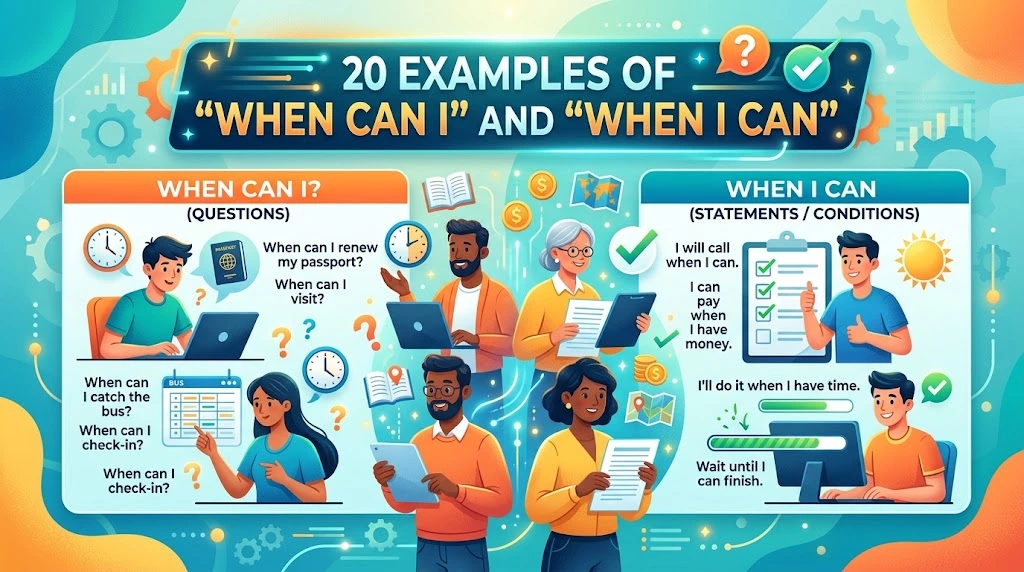
The following examples show how both expressions work in everyday English.
Examples of “When Can I”
- When can I submit my assignment?
- When can I visit your office?
- When can I start my new job?
- When can I collect my passport?
- When can I speak to the principal?
- When can I book an appointment?
- When can I use the meeting room?
- When can I receive the results?
- When can I join the training session?
- When can I expect your response?
Examples of “When I Can”
- I will call you when I can.
- I exercise when I can.
- I help my family whenever I can.
- I will finish the report when I can.
- I visit my friends when I can.
- I read books when I can find the time.
- I try to learn new words when I can.
- I will send you the files when I can.
- I clean my room whenever I can.
- I volunteer when I can.
These examples illustrate the basic difference: “When can I” usually asks a direct question, while “when I can” commonly explains timing within a statement.
Common Mistakes and Corrections
English learners sometimes use the correct words in the wrong order. Here are the mistakes worth avoiding.
Mistake 1: Using Direct-Question Word Order in an Indirect Question
Incorrect: Do you know when can I apply?
Correct: Do you know when I can apply?
Why? The embedded question follows statement word order.
Mistake 2: Using Statement Word Order in a Direct Question
Incorrect: When I can start the course?
Correct: When can I start the course?
Why? A direct question with can normally places the modal verb before the subject.
Mistake 3: Adding “To” After “Can”
Incorrect: When can I to visit you?
Correct: When can I visit you?
Why? Modal verbs are followed by the base form of a verb without to.
Mistake 4: Confusing “When I Can” With “Whenever I Can”
Both are correct, but whenever I can often emphasizes that an action happens at any available opportunity.
Examples:
- I help my parents when I can.
- I help my parents whenever I can.
Both sentences are natural. The second places slightly more emphasis on helping whenever an opportunity arises.
Mistake 5: Thinking Every Question Must Use “When Can I”
Not every sentence containing a question needs this word order.
Compare:
- When can I register? — Direct question.
- Do you know when I can register? — Indirect question.
The second sentence is a question, but the embedded clause uses when I can.
Mistake 6: Confusing “When I Can” With “When I Could”
Can commonly describes present ability or a possible opportunity. Could may refer to past ability, a hypothetical situation, or a polite possibility.
Examples:
- I will help when I can.
- I helped whenever I could.
The first refers to present or future availability. The second describes past opportunities.
Comparison Table: When Can I vs When I Can
| Feature | When can I | When I can |
|---|---|---|
| Main use | Direct question | Statement or embedded question |
| Word order | When + can + I | When + I + can |
| Typical punctuation | Question mark | Depends on the full sentence |
| Example | When can I leave? | I will leave when I can. |
| Indirect question | Not normally used in this order | Can you tell me when I can leave? |
| Main purpose | Ask about timing or opportunity | Explain timing or opportunity |
When Can I vs Can I When
The natural word order depends on the sentence.
- When can I call you? — Correct direct question.
- Can I call you when I arrive? — Also correct, but it asks for permission or checks whether the call is acceptable at a particular time.
The second sentence does not use can I when. Instead, the main question begins with can I, and the when-clause explains the timing.
Verb Usage: How “Can” Works in English
The word can is a modal verb. It is used to express ability, permission, and possibility.
1. Can for Ability
Examples:
- When can I swim without assistance?
- I can speak English.
- Can I solve this problem?
2. Can for Permission
Examples:
- When can I enter the building?
- Can I use your phone?
- When can I take a break?
3. Can for Possibility
Examples:
- When can I expect the package?
- I will visit when I can.
- We can meet when everyone is available.
4. Can With Different Subjects
The verb can does not change according to the subject.
| Subject | Correct example |
|---|---|
| I | When can I leave? |
| You | When can you leave? |
| He | When can he leave? |
| She | When can she leave? |
| We | When can we leave? |
| They | When can they leave? |
Unlike many present-tense verbs, can does not take an -s ending with he or she.
Incorrect: When cans she leave?
Correct: When can she leave?
Tenses Connection: How “When Can I” Relates to English Tenses
Understanding English tenses can help you choose between can, could, and other expressions.
1. Present and Future Possibilities
Use can to ask about present ability, permission, or an opportunity that may arise in the future.
Examples:
- When can I speak to you?
- When can I begin the project?
- I will start when I can.
Although the question may refer to a future event, the modal can remains in its base form.
2. Past Situations With “Could”
Use could when asking about past ability or describing past opportunities.
Examples:
- When could I first access the system?
- I helped whenever I could.
- She visited us when she could.
The exact meaning depends on the context.
3. Future Plans With “Will”
You can use will in the main clause while keeping can in a time clause.
Examples:
- I will call you when I can.
- I will submit the form when I can.
- We will meet when we can arrange a suitable time.
Do not add will directly after when in a clause referring to a future time.
Incorrect: I will call you when I will can.
Correct: I will call you when I can.
Related Grammar Topics
Some English grammar subjects are useful to learn alongside modal verbs, but they follow separate rules.
- Use of had: “I had finished my work before the meeting.”
- Has vs have: “She has a car, but they have bicycles.”
- Future indefinite tense examples: “I will travel tomorrow.”
- 10 examples of adjective: happy, tall, bright, kind, careful, small, beautiful, honest, quick, and helpful.
These topics can strengthen your understanding of verbs, sentence structure, and tenses. However, they should not be forced into a sentence about when can I unless they genuinely help explain the grammar.
Clauses and Grammar Usage

A clause is a group of words containing a subject and a verb. The difference between direct and indirect questions becomes clearer when you identify the clauses in a sentence.
1. Independent Clauses
An independent clause can express a complete thought.
Example:
“I will call you when I can.”
The main clause is “I will call you.” The time clause is “when I can.”
Together, they form a complete sentence.
2. Time Clauses
A time clause explains when an action happens.
Examples:
- I will eat when I can.
- She will visit when she can.
- We will leave when we can.
The clause beginning with when explains the timing of the action.
3. Embedded Question Clauses
An embedded question appears inside a larger sentence.
Examples:
- I know when I can leave.
- Tell me when I can start.
- Do you remember when I can collect the keys?
In these examples, when I can is part of a larger grammatical structure. It does not use the direct-question word order.
4. Direct Questions and Punctuation
Direct questions normally end with a question mark.
Examples:
- When can I start?
- When can I leave?
- When can I meet you?
However, the punctuation of a sentence containing an embedded question depends on the complete sentence.
- I know when I can start. — Statement.
- Can you tell me when I can start? — Direct question containing an embedded question.
This is why both word order and punctuation matter.
Tips to Remember the Difference
Use these simple techniques to make the grammar rule easier to remember.
- Ask directly? Use “When can I…?”
- Making a statement? Use “…when I can.”
- Asking indirectly? Use “Can you tell me when I can…?”
- Using a modal verb? Follow can with the base form of the verb.
- Unsure about word order? Identify whether when begins a direct question or an embedded clause.
Practice with familiar situations, such as asking about a meeting, planning a visit, or discussing work deadlines. Repeating these patterns will help you use them naturally.
Frequently Asked Questions
1. Is “When Can I” Correct English?
Yes. When can I is correct when asking a direct question about time, permission, ability, or opportunity. For example, “When can I start the course?”
2. Is “When I Can” Grammatically Correct?
Yes. When I can is correct in statements and indirect questions. For example, “I will help you when I can” and “Do you know when I can apply?”
3. Should I Say “When Can I” or “When I Can” in a Question?
Use when can I in a direct question, such as “When can I leave?” Use when I can in an indirect question, such as “Could you tell me when I can leave?”
4. Why Is “Tell Me When Can I Go” Incorrect?
The sentence uses direct-question word order inside an indirect question. The correct version is “Tell me when I can go.”
5. Can I Use “When I Can” for Future Actions?
Yes. You can say, “I will call you when I can.” The phrase describes a future opportunity without requiring will inside the time clause.
Conclusion
The difference between when can I vs when I can comes down to sentence structure. Use when can I when asking a direct question, such as “When can I start?” Use when I can in a statement or an indirect question, such as “I will start when I can” or “Can you tell me when I can start?”
Remember that direct questions usually place the modal verb before the subject, while statements and embedded questions use normal subject-verb order. Also, can must be followed by the base form of a verb. Once you understand these simple rules, you can avoid common grammar mistakes and communicate more clearly. Practice with everyday examples, pay attention to word order, and you will soon use both expressions confidently in conversations, emails, and English writing.

1 thought on “When Can I vs When I Can: Meaning, Grammar Rules, and Examples”